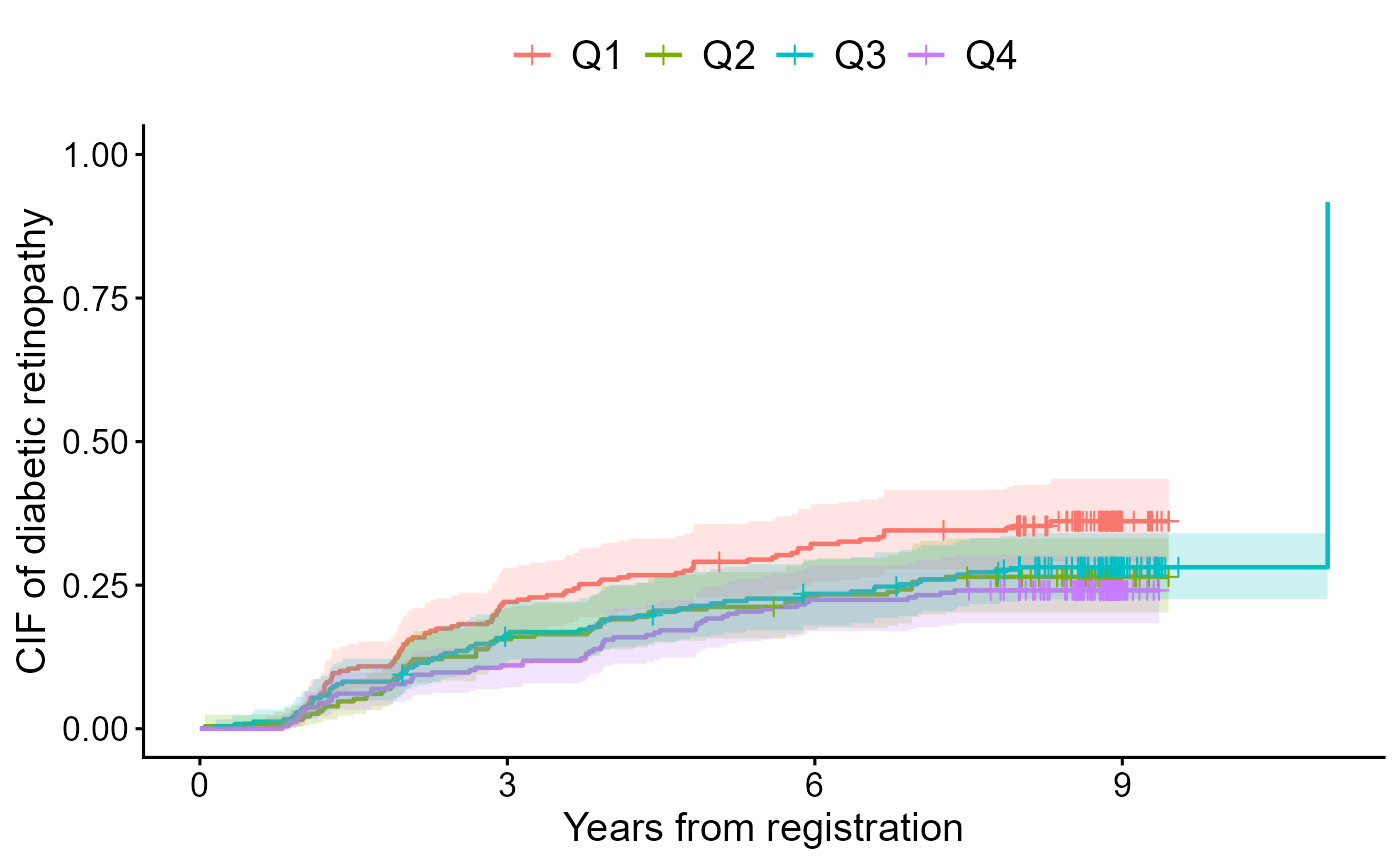
Generate a survival/CIF curve with marks that represent censoring, competing risks and intercurrent events
Source:R/cifplot.R
cifplot.RdThis function generates a survival or CIF curve from a unified formula–data
interface or from an existing survfit object. When a formula is supplied,
the LHS is typically Event() or survival::Surv(), and the RHS specifies
an optional stratification variable. In addition to the curves themselves,
cifplot() can add numbers-at-risk tables, tables of point estimates and
CIs, censoring marks, competing-risk marks, and intercurrent-event marks.
For usual single-panel mode, the function returns an object whose plot
component is a regular ggplot object that can be further modified
(compatible with + and %+%).
For more complex multi-panel displays, cifplot() can internally call
cifpanel() via several “panel modes” (per event, per variable, or
censoring-focused).
Usage
cifplot(
  formula_or_fit,
  data = NULL,
  weights = NULL,
  subset.condition = NULL,
  na.action = na.omit,
  outcome.type = "competing-risk",
  code.event1 = 1,
  code.event2 = 2,
  code.censoring = 0,
  code.events = NULL,
  error = NULL,
  conf.type = "arcsine-square root",
  conf.int = 0.95,
  n.risk.type = c("weighted", "unweighted", "ess"),
  type.y = NULL,
  label.x = "Time",
  label.y = NULL,
  label.strata = NULL,
  level.strata = NULL,
  order.strata = NULL,
  limits.x = NULL,
  limits.y = NULL,
  breaks.x = NULL,
  breaks.y = NULL,
  use.coord.cartesian = FALSE,
  add.conf = TRUE,
  add.risktable = TRUE,
  add.estimate.table = FALSE,
  symbol.risk.table = "square",
  font.size.risk.table = 3,
  add.censor.mark = TRUE,
  shape.censor.mark = 3,
  size.censor.mark = 2,
  add.competing.risk.mark = FALSE,
  competing.risk.time = list(),
  shape.competing.risk.mark = 16,
  size.competing.risk.mark = 2,
  add.intercurrent.event.mark = FALSE,
  intercurrent.event.time = list(),
  shape.intercurrent.event.mark = 1,
  size.intercurrent.event.mark = 2,
  add.quantile = FALSE,
  level.quantile = 0.5,
  panel.per.event = FALSE,
  panel.censoring = FALSE,
  panel.per.variable = FALSE,
  panel.mode = "auto",
  rows.columns.panel = NULL,
  style = "classic",
  palette = NULL,
  linewidth = 0.8,
  linetype = FALSE,
  font.family = "sans",
  font.size = 12,
  legend.position = "top",
  print.panel = FALSE,
  filename.ggsave = NULL,
  width.ggsave = 6,
  height.ggsave = 6,
  dpi.ggsave = 300,
  survfit.info = NULL,
  axis.info = NULL,
  visual.info = NULL,
  panel.info = NULL,
  style.info = NULL,
  inset.info = NULL,
  print.info = NULL,
  ggsave.info = NULL,
  ...
)
Arguments
- formula_or_fit
Either a model formula or a survfit object. When a formula is supplied, the LHS must be
Event(time, status)orSurv(time, status). The RHS specifies an optional stratification variable.- data
A data frame containing variables in the formula.
- weights
Optional name of the weight variable in
data. Weights must be nonnegative.- subset.condition
Optional character string giving a logical condition to subset
data(defaultNULL).- na.action
A function specifying the action to take on missing values (default
na.omit).- outcome.type
Character string specifying the type of time-to-event outcome. One of
"survival"(Kaplan-Meier) or"competing-risk"(Aalen-Johansen). IfNULL(default), the function automatically infers the outcome type from the data: if the event variable has more than two unique levels,"competing-risk"is assumed; otherwise,"survival"is used. You can also use abbreviations such as"S"or"C". Mixed or ambiguous inputs (e.g.,c("S", "C")) trigger automatic detection based on the event coding.- code.event1
Integer code of the event of interest (default
1).- code.event2
Integer code of the competing risk (default
2).- code.censoring
Integer code of censoring (default
0).- code.events
Optional specification of event/censoring codes. For single-panel calls, supply a numeric vector. For competing-risk outcomes, use
c(event1, event2, censoring). For survival outcomes, a length-2 or length-3 vector is allowed:c(event, censoring)orc(event, *, censoring), where any middle element is ignored. When supplied, this argument overridescode.event1,code.event2, andcode.censoringfor the purpose of estimation. For panel displays (e.g.cifpanel()or whenpanel.per.event = TRUEorpanel.censoring = TRUE),code.eventsmay also be a list of such numeric vectors, one per panel.- error
Character string specifying the method for SEs and CIs used internally. For
"survival"without weights, choose one of"greenwood"(default),"tsiatis", or"if". For"competing-risk"without weights, choose one of"delta"(default),"aalen", or"if". SEs and CIs based on influence functions ("if") is recommended for weighted analysis.- conf.type
Character specifying the method of transformation for CIs used internally (default
arcsine-square root).- conf.int
Numeric two-sided level of CIs (default
0.95).- n.risk.type
Character string; one of
"weighted","unweighted", or"ess". Controls which risk set size is returned in$n.riskwithout affecting estimates or SEs (default"weighted").- type.y
Character string specifying the y-scale. For survival/CIF curves,
"surv"implies survival probabilities and"risk"implies CIF (1-survival in simple survival settings). Specify"cumhaz"to plot cumulative hazard or"cloglog"to generate a complementary log-log plot. IfNULL, a default is chosen fromoutcome.typeor the survfit object.- label.x
Character x-axis label (default
"Time").- label.y
Character y-axis label (default is chosen automatically from
outcome.typeandtype.y, e.g. "Survival", "Cumulative incidence" or "Cumulative hazard").- label.strata
Character vector or named character vector specifying labels for strata. Names (if present) must match the (re-ordered) underlying strata levels. Note: when any of the panel modes is active (
panel.per.variable = TRUE,panel.per.event = TRUE,panel.censoring = TRUE, orpanel.mode = "auto"and it actually dispatches to a panel), strata labels are suppressed to avoid duplicated legends across sub-plots.- level.strata
Optional character vector giving the full set of expected strata levels. When provided, both
order.strataandlabel.strataare validated against it before application.- order.strata
Optional character vector specifying the display order of strata in the legend/number-at-risk table. Specify the levels of strata. Levels not listed are dropped.
- limits.x
Numeric length-2 vector specifying x-axis limits. If
NULL, it is set from the fitted object (typicallyc(0, max(time))).- limits.y
Numeric length-2 vector specifying y-axis limits. If
NULL, it is set toc(0, 1)for probability-type outcomes.- breaks.x
Numeric vector of x-axis breaks (default
NULL).- breaks.y
Numeric vector of y-axis breaks (default
NULL).- use.coord.cartesian
Logical; if
TRUE, usesggplot2::coord_cartesian()for zooming instead of changing the scale limits (defaultFALSE).- add.conf
Logical; if
TRUE, adds a CI ribbon (viaggsurvfit::add_confidence_interval()). DefaultTRUE.- add.risktable
Logical; if
TRUE, adds a numbers-at-risk table under the plot. DefaultTRUE. Note: when a panel mode is active, tables are suppressed.- add.estimate.table
Logical; if
TRUE, adds a table of estimates and CIs. DefaultFALSE. Note: when a panel mode is active, tables are suppressed.- symbol.risk.table
Character specifying the symbol used in the risk table to denote strata:
"square","circle", or"triangle"(default"square").- font.size.risk.table
Numeric font size for texts in risk / estimate tables (default
3).- add.censor.mark
Logical; if
TRUE, draws censoring marks on each curve (viaggsurvfit::add_censor_mark()). DefaultTRUE.- shape.censor.mark
Integer point shape used for censoring marks (default
3).- size.censor.mark
Numeric point size used for censoring marks (default
2).- add.competing.risk.mark
Logical; if
TRUE, draws time marks for the competing event (event 2). If no times are supplied viacompeting.risk.time, the function tries to extract them automatically from the data. DefaultFALSE.- competing.risk.time
A named list of numeric vectors. Each name must correspond to a strata label, and its numeric vector gives the times at which the competing event occurred in that stratum. Typically left as
list()and filled internally.- shape.competing.risk.mark
Integer point shape for competing-risk marks (default
16).- size.competing.risk.mark
Numeric point size for competing-risk marks (default
2).- add.intercurrent.event.mark
Logical; if
TRUE, overlays user-specified intercurrent-event times per stratum. DefaultFALSE.- intercurrent.event.time
A named list of numeric vectors for intercurrent events (names must match strata labels).
- shape.intercurrent.event.mark
Integer point shape for intercurrent-event marks (default
1).- size.intercurrent.event.mark
Numeric point size for intercurrent-event marks (default
2).- add.quantile
Logical; if
TRUE, adds a quantile reference line (viaggsurvfit::add_quantile()). DefaultFALSE.- level.quantile
Numeric quantile level to be shown (default
0.5for the median).- panel.per.event
Logical. Explicit panel mode. If
TRUEandoutcome.type == "competing-risk",cifplot()internally callscifpanel()to display two event-specific CIFs side-by-side (event 1 and event 2) using reversedcode.events. Ignored for non-competing-risk outcomes.- panel.censoring
Logical. Explicit panel mode. If
TRUEandoutcome.type == "survival",cifplot()internally callscifpanel()to display KM curves for(event, censor)and(censor, event)so that censoring patterns can be inspected.- panel.per.variable
Logical. Explicit panel mode. If
TRUEand the RHS of the formula has multiple covariates (e.g.~ a + b + c), the function produces a panel where each variable in the RHS is used once as the stratification factor.- panel.mode
Character specifying Automatic panel mode. If
"auto"and none ofpanel.per.variable,panel.per.event,panel.censoringhas been set toTRUE, the function chooses a suitable panel mode automatically: (i) if the formula RHS has 2+ variables, it behaves likepanel.per.variable = TRUE; (ii) otherwise, ifoutcome.type == "competing-risk", it behaves likepanel.per.event = TRUE; (iii) otherwise, ifoutcome.type == "survival", it behaves likepanel.censoring = TRUE. If a panel mode is explicitly specified,panel.modeis ignored.- rows.columns.panel
Optional integer vector
c(nrow, ncol)controlling the layout of the panel returned by the panel modes. IfNULL, an automatic layout is determined from the number of subplots.- style
Character choosing the base plot style:
"classic","bold","framed","grid","gray"or"ggsurvfit"(default"classic"). Abbreviations such as"C","B","F", or"G"are also accepted.- palette
Optional character vector specifying the color palette to use across strata.
- linewidth
Optional numeric specifying the line width of curve (default
0.8).- linetype
Optional logical using different line types of curve (default
FALSE).- font.family
Character specifying the font family:
"sans","serif", or"mono"(default"sans").- font.size
Integer specifying the base font size (default
12).- legend.position
Character specifying the legend position:
"top","right","bottom","left", or"none"(default"top").- print.panel
Logical. When
TRUE, panel displays created internally are printed automatically in interactive sessions; otherwise they are returned invisibly for further modification (defaultFALSE).- filename.ggsave
Character; if non-
NULL, save the plot to this file.- width.ggsave
Numeric width passed to
ggplot2::ggsave()(default6).- height.ggsave
Numeric height passed to
ggplot2::ggsave()(default6).- dpi.ggsave
Numeric DPI passed to
ggplot2::ggsave()(default300).- survfit.info, axis.info, visual.info, panel.info, style.info, inset.info, print.info, ggsave.info
Internal lists used for programmatic control. Not intended for direct user input.
- ...
Additional arguments passed to internal helper functions.
Value
A "cifplot" object (a list) with at least the following elements:
plot: a ggplot object containing the main plotpatchwork: reserved for compatibility with panel displays (typicallyNULLfor single-panel plots)survfit.info,axis.info,visual.info,panel.info,style.info,inset.info,print.info,ggsave.info: internal lists storing the fitted curves and display settingsversion: a character string giving the cifmodeling version usedcall: the original function call
When a panel mode is active and print.panel = TRUE, the panel is also printed in interactive sessions.
Details
Typical use cases
Draw one survival/CIF curve set by exposure groups (e.g., treatment vs control).
Call
cifpanel()with a simplified code to create a panel displaying plots of multiple stratified survival/CIF curves or CIF curves for each event type.Add CIs and censor/competing-risk/intercurrent-event marks.
Add number-at-risk table to display the number at risk or the estimated survival probabilities or CIFs and CIs at each point in time.
Key arguments shared with cifcurve()
Outcome type and estimator
outcome.type = "survival": Kaplan-Meier estimatoroutcome.type = "competing-risk": Aalen-Johansen estimator
Confidence intervals
conf.intsets the two-sided level (default 0.95)conf.typechooses the transformation ("arcsine-square root","plain","log","log-log","logit", or"none")errorchooses the estimator for SE ("greenwood","tsiatis"or"if"for survival curves and"delta","aalen"or"if"for CIFs)
Risk sets used in tables
n.risk.typecontrols whether$n.riskreflects weighted, unweighted, or effective sample size counts when building risk tables (forwarded tocifcurve()); when a fittedsurvfitobject is supplied, existing risk sets are used as-is.
Key arguments for cifplot()
Data visualization
add.confadds CIs on the ggplot2-based plotadd.competing.risk.markandadd.intercurrent.event.markadds symbols to describe competing risks or intercurrent events in addition to conventional censoring marks withadd.censor.markadd.risktableadds numbers at riskadd.estimate.tableadds time-by-time estimates and CIsadd.quantileadds a reference line at a chosen quantile level
Plot customization
type.ychooses y-axis ("surv"for survival and"risk"for 1-survival/CIF)limits.x,limits.y,breaks.x,breaks.y: numeric vectors for axis controlstylespecifies the appearance of plot ("classic","bold","framed","grid","gray"or"ggsurvfit")palettespecifies color of each curve (e.g.palette=c("blue1", "cyan3", "navy", "deepskyblue3")))
Panel display
panel.per.variableproduces multiple survival/CIF curves per stratification variable specified in the formulapanel.per.eventproduces CIF curves for each event typepanel.censoringproduces the Kaplan–Meier curves for (event, censor) and (censor, event) so that censoring patterns can be inspectedpanel.modeuses automatic panel mode
When panel.per.event = TRUE, two panels are created with
code.events = list(c(e1, e2, c), c(e2, e1, c)), where
code.events = c(e1, e2, c) is the input coding for event1, event2, and censoring.
Common legend is collected by default (legend.collect = TRUE).
Numeric stratification variables are normalized automatically. Columns with fewer than nine distinct numeric values are coerced to factors; columns with nine or more distinct numeric values are split at the median into “Below median” and “Above median” strata.
Advanced control not required for typical use
The arguments below fine-tune internal estimation and figure appearance. Most users do not need to change these defaults.
Graphical layers
| Argument | Description | Default |
add.conf | Add confidence interval ribbon. | TRUE |
add.risktable | Add numbers-at-risk table below the plot. | TRUE |
add.estimate.table | Add estimates and confidence intervals table. | FALSE |
symbol.risk.table | Symbol for strata in risk / estimate tables | "square" |
font.size.risk.table | Font size for texts in risk / estimate tables | 3 |
add.censor.mark | Add censoring marks. | TRUE |
add.competing.risk.mark | Add marks for event2 of "competing-risk" outcome. | FALSE |
add.intercurrent.event.mark | Add intercurrent event marks at user-specified times. | FALSE |
add.quantile | Add quantile reference lines. | FALSE |
level.quantile | Quantile level for add.quantile. | 0.5 |
Time for marks
| Argument | Description |
competing.risk.time | Named list of numeric vectors that contains times of competing risks. Names must match strata labels. Typically created internally |
intercurrent.event.time | Named list of numeric vectors that contains times of intercurrent events. Names must match strata labels. Typically created by extract_time_to_event(). |
Appearance of marks
| Argument | Applies to | Default |
shape.censor.mark | Censoring marks | 3 (cross) |
size.censor.mark | Censoring marks | 2 |
shape.competing.risk.mark | Competing-risk marks | 16 (filled circle) |
size.competing.risk.mark | Competing-risk marks | 2 |
shape.intercurrent.event.mark | Intercurrent marks | 1 (circle) |
size.intercurrent.event.mark | Intercurrent marks | 2 |
Panel display
| Argument | Description |
panel.per.variable | One panel per stratification variable |
panel.per.event | For "competing-risk", show CIFs of event 1 and event 2 |
panel.censoring | For survival, show (event, censor) vs (censor, event) |
panel.mode with 2+ stratification variables | Behave like panel.per.variable |
panel.mode with outcome.type = "competing-risk" | Behave like panel.per.event |
panel.mode with outcome.type = "survival" | Behave like panel.censoring |
Axes and legend
| Argument | Description | Default |
limits.x, limits.y | Axis limits (c(min, max)) | Auto |
breaks.x, breaks.y | Tick breaks for x and y axes | Auto |
use.coord.cartesian | For zooming use coord_cartesian() | FALSE |
legend.position | "top", "right", "bottom", "left", "none" | "top" |
Export
| Argument | Description | Default |
filename.ggsave | If non-NULL, save the plot using ggsave() | NULL |
width.ggsave | Size passed to ggsave() | 6 |
height.ggsave | Size passed to ggsave() | 6 |
dpi.ggsave | DPI passed to ggsave() | 300 |
Notes
For CIF displays, set
type.y = "risk". For survival scale, usetype.y = NULLor= "surv". For a cumulative hazard plot, usetype.y = "cumhaz". To generate a log-log plot, usetype.y = "cloglog".Event coding can be controlled via
code.event1,code.event2,code.censoring. For ADaM-style data, usecode.event1 = 0,code.censoring = 1.Per-stratum time lists should have names identical to plotted strata labels.
![[Stable]](figures/lifecycle-stable.svg)
See also
polyreg() for log-odds product modeling of CIFs; cifcurve() for KM/AJ estimators; cifpanel() for display of multiple CIFs; ggsurvfit::ggsurvfit, patchwork::patchwork and modelsummary::modelsummary for display helpers.