Quick start
Are you comfortable writing Surv(time, status) ~ strata
but hesitant to dive into the Fine-Gray models or custom
ggplot2 code? cifmodeling helps
clinicians, epidemiologists, and applied researchers move from basic
Kaplan-Meier curves to clear, publication-ready survival and competing
risk plots – with just a few lines of R.
It provides a unified, high-level interface for survival and competing risks analysis, combining nonparametric estimation, regression modeling, visualization, and lightweight flowchart summaries.
library(cifmodeling)
data(diabetes.complications)
cifplot(Event(t,epsilon)~fruitq, data=diabetes.complications,
        outcome.type="competing-risk", panel.per.event=TRUE)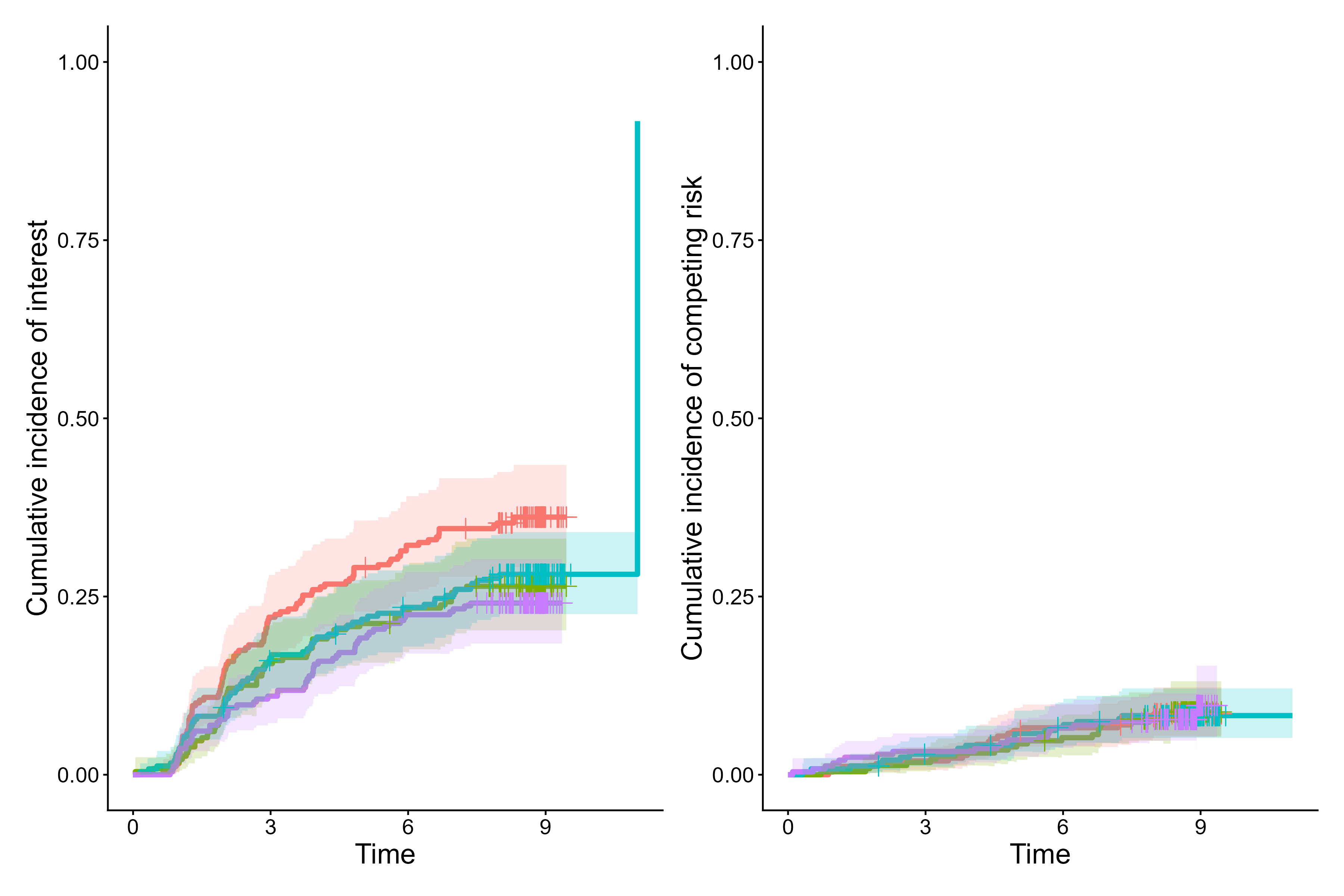
Aalen-Johansen cumulative incidence curves from cifplot()
In competing risks data, censoring is often coded as 0, the event of
interest as 1, and competing risks as 2. In the
diabetes.complications data frame, epsilon
follows this convention. With panel.per.event = TRUE,
cifplot() visualizes both competing events, with the CIF of
diabetic retinopathy (epsilon = 1) shown on the left and
the CIF of macrovascular complications (epsilon = 2) on the
right.
Before fitting a model, it is often helpful to check how many
observations are in each group and what outcome status they have at a
clinically relevant time point. cifflowchart() provides a
compact, CONSORT-like summary of treatment groups, exclusions, and
outcome status using the same formula style.
cifmodeling::cifflowchart(
  Event(t, epsilon) ~ fruitq1,
  data = diabetes.complications,
  time.point = 8,
  outcome.type = "competing-risk"
)
Why cifmodeling?
In clinical and epidemiologic research, analysts often need to handle censoring, competing risks, intercurrent events (e.g. treatment switching), and descriptive checks of the analysis population, but existing R packages typically separate these tasks across different interfaces. cifmodeling provides a unified, publication-ready toolkit that integrates nonparametric estimation, regression modeling, visualization, and lightweight flowchart summaries for survival and competing risks data. The tools assist users in the following ways:
-
Unified interface for the Kaplan–Meier and
Aalen–Johansen curves, with survival and competing risks handled by the
same
Event()+ formula + data syntax. -
Effects on the CIF scale: while the Fine-Gray
models subdistribution hazards,
polyreg()directly targets ratios of CIFs (risk ratios, odds ratios, subdistribution hazard ratios), so parameters align closely with differences seen in CIF curves. -
Coherent, joint modeling of all competing events:
polyreg()models all cause-specific CIFs together, parameterizing the nuisance structure with polytomous log odds products and enforcing that their CIFs sum to at most one. -
Tidy summaries and reporting: support for
generics::tidy(),glance(), andaugment(), which integratepolyreg()smoothly withmodelsummaryand other broom-style tools. -
Publication-ready graphics built on
ggsurvfitandggplot2, including number-at-risk/CIF+CI tables, censoring/competing-risk/intercurrent-event marks, and multi-panel layouts. -
Descriptive flowcharts with
cifflowchart(), which summarizes exclusions, groups, and observed outcome status before formal estimation or modeling.
Tools for survival and competing risks analysis
The cifmodeling package is centered around a small set of connected functions:
-
cifcurve()computes Kaplan-Meier and Aalen-Johansen estimates and returns a survfit-compatible object. -
cifplot()generates a survival or cumulative incidence function (CIF) curve. The visualization is built on top ofggsurvfitandggplot2. -
cifpanel()creates multi-panel displays for survival/CIF curves, arranged either in a grid layout or as an inset overlay. -
cifflowchart()creates a lightweight flowchart of exclusions, groups, and outcome status. It is intended as a descriptive check of the analysis population, not as a full CONSORT automation tool. -
polyreg()fits coherent regression models on all cause-specific CIFs simultaneously to estimate RR/OR/SHR, offering a practical complement to Fine-Gray.
These functions adopt a formula + data syntax, return practical
outputs for estimation, visualization, and reporting, and integrate with
ggsurvfit, DiagrammeR, and
modelsummary where appropriate.
Explore the main features visually:
See the Gallery for a curated set of examples usingcifplot()andcifpanel().
Interested in the precise variance formulas and influence functions for the Aalen-Johansen estimator?
Visit Computational formulas in cifcurve().
Learn the modeling framework with
polyreg():
See the Direct polytomous regression for coherent, joint modeling of all cause-specific CIFs.
Prefer to build intuition before diving into code?
Visit the Coffee and Research – Story and Quiz series for narrative-style introductions to study design, survival and competing risks analysis, and frequentist and causality thinking: https://gestimation.github.io/coffee-and-research/en/
Position in the survival ecosystem
Several excellent R packages exist for survival and competing risks
analysis. The survival package provides the canonical
API for survival data. In combination with the
ggsurvfit package, survival::survfit() can
produce publication-ready survival plots. For CIF plots, however,
integration in the general ecosystem is less streamlined.
cifmodeling fills this gap by offering
cifplot() for survival/CIF plots and multi-panel figures
via a single, unified interface.
Beyond providing a unified interface, cifcurve() also
extends survfit() in a few targeted ways. For unweighted
survival data, it reproduces the standard Kaplan-Meier estimator with
Greenwood and Tsiatis SEs and a unified set of CI
transformations. For competing risks data, it computes Aalen-Johansen
CIFs with both Aalen-type and delta-method SEs. For
weighted survival or competing risks data (e.g. inverse probability
weighting), it implements influence-function based SEs
(Deng and Wang 2025) as well as modified Greenwood- and
Tsiatis-type SEs (Xie and Liu 2005), which are valid under
general positive weights.
If you need very fine-grained plot customization, you can compute the
estimator and keep a survfit-compatible object with
cifcurve() (or supply your own survfit object) and then
style it using ggsurvfit/ggplot2 layers. In other
words:
- use
cifcurve()for estimation, - use
cifplot()/cifpanel()for quick, high-quality figures, - use
cifflowchart()for compact summaries of exclusions, groups, and outcome status, and - fall back to the
ggplotecosystem when you want full artistic control.
The causalRisk package offers IPW-based estimation of counterfactual cumulative risks and hazards. It is most relevant when treatment, censoring, and missingness mechanisms must be modeled explicitly. In contrast, cifmodeling focuses on nonparametric estimation and direct CIF regression rather than structural causal models.
The mets package is a more specialized toolkit that
provides advanced methods for competing risks analysis.
cifmodeling::polyreg() focuses on coherent modeling of all
CIFs simultaneously to estimate the exposure effects in terms of
RR/OR/SHR. This coherence can come with longer runtimes for large
problems. If you prefer fitting separate regression models for each
competing event or specifically need the Fine-Gray models (Fine and Gray
1999) and the direct binomial models (Scheike, Zhang and Gerds 2008),
mets::cifreg() and mets::binreg() are
excellent choices.
In short, cifmodeling provides a unified high-level grammar for estimation, visualization, descriptive flowcharts, and direct CIF regression — something no existing package currently offers in one place.
| Function | cifmodeling | survival | cmprsk | mets | ggsurvfit |
|---|---|---|---|---|---|
| AJ estimator | Yes | Yes (multistate survfit) |
Yes (cuminc) |
Yes | Depends on input |
| Weighted AJ estimator and valid SE | Yes (IPW + IF-based SE) | Yes (case weights / robust SE) | No | Yes (IPW + IF-based SE) | Depends on input |
| Gray test | No | No (only log-rank via survdiff) |
Yes (cuminc) |
No |
tidycmprsk::glance() + add_pvalue()
|
| Fine–Gray model | No |
finegray+coxph
|
crr |
cifregFG |
No |
| Direct CIF regression | polyreg |
No | No |
cifreg, binreg
|
No |
| Surv()/Event() interface | Yes (Event, Surv) |
Yes (Surv) |
No (ftime/fstatus) |
Yes (Event, Surv) |
Yes (Surv, ggcuminc + tidiers) |
| Publication-ready survival/CIF plot | Yes (cifplot, cifpanel) |
plot (base) |
plot.cuminc (base) |
plot (base) |
Designed for publication |
| Support for tidy/glance/augment | Yes (polyreg + methods) |
Yes (via broom) | Yes (via tidycmprsk) | No | Yes (via broom) |
Installation
The package is implemented in R and relies on Rcpp,
nleqslv and boot for its numerical back-end.
The examples in this document also use ggplot2,
ggsurvfit, patchwork and
modelsummary for tabulation and plotting. Install the core
package and these companion packages with:
# Install cifmodeling with core dependencies
install.packages(c("cifmodeling", "Rcpp", "nleqslv", "boot"))

# Recommended packages for plotting and tabulation in this README
install.packages(c("ggplot2", "ggsurvfit", "patchwork", "modelsummary"))
Quality control
cifmodeling includes an extensive test suite built
with testthat, which checks the numerical accuracy and
graphical consistency of all core functions (cifcurve(),
cifplot(), cifpanel(),
cifflowchart(), and polyreg()). The estimators
are routinely compared against related functions in
survival, cmprsk and
mets packages to ensure consistency. The package is
continuously tested on GitHub Actions (Windows, macOS, Linux) to
maintain reproducibility and CRAN-level compliance.