Eight elements of causal inference preserved in Japanese
One intriguing property of kanji characters—the logographic characters used in Japanese and Chinese—is that traces of their ancient meanings remain embedded in their internal structure. When we analyze the characters corresponding to causal inference, a small but revealing discovery emerges.
The first character is in. Imagine a large square. Originally, this square represented a mat or a surface, but it was also used as a motif for space, or even the universe itself. Within this square lies a single human figure, arms and legs outstretched. This image retains a sense of a human being entrusting themselves to the universe or the world around them.
The second character, ga (or ka), is more concrete. It is composed of two vertical parts. The lower part represents a tree. Above it is a shape that depicts fruit growing on the branches—fruit that has reached full maturity. Here, ga signifies not a process in progress, but something that has fully developed and come to completion.
The third character, sui, also splits in two—this time left and right: a hand on the left, a bird on the right. Originally, this likely evoked a concrete action, such as attempting to grasp or push something forward. Over time, that literal image faded, and the character took on a more abstract meaning. From a modern perspective, it is more natural to read these components broadly as action and object.
The final character, ron, is the most abstract. Let us begin with its right-hand component. This element conveys the idea of arranging multiple elements in an orderly and structured way. On the left is a component that, even in modern form, directly signifies language. Together, ron represents the act of giving structure and order to ideas through words.
Taken together, causal inference—when expressed in Japanese—can be seen as composed of eight elements:
- the universe,
- the human being,
- the tree,
- the fruit,
- action,
- object,
- language,
- and order.
Causality, in this reading, is both a law of nature and a human-centered way of understanding the world. It is also an activity in which the order inherent in those laws is articulated and made explicit through language.
Doesn’t it feel as though all the essential components of what contemporary researchers and philosophers now call causal inference are already present here? And aren’t you tempted to see the kanji we’ve been analyzing?
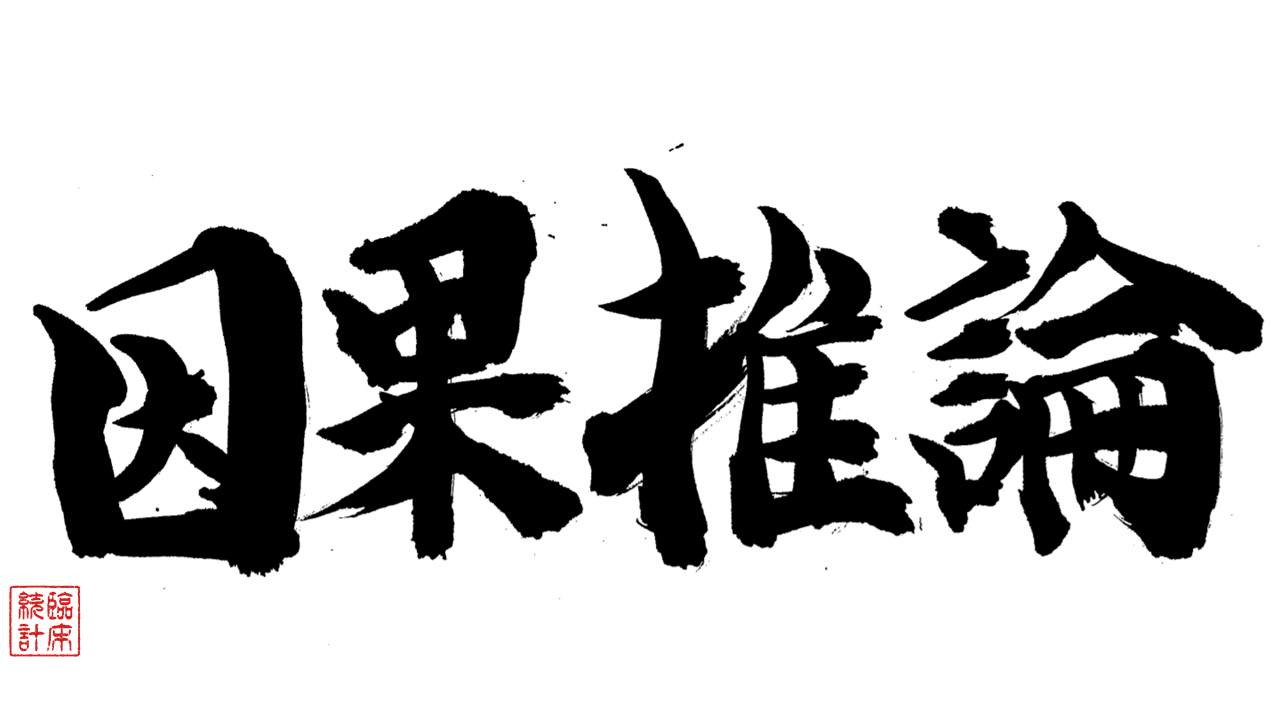 Calligraphy by Eiji Sakurai.